
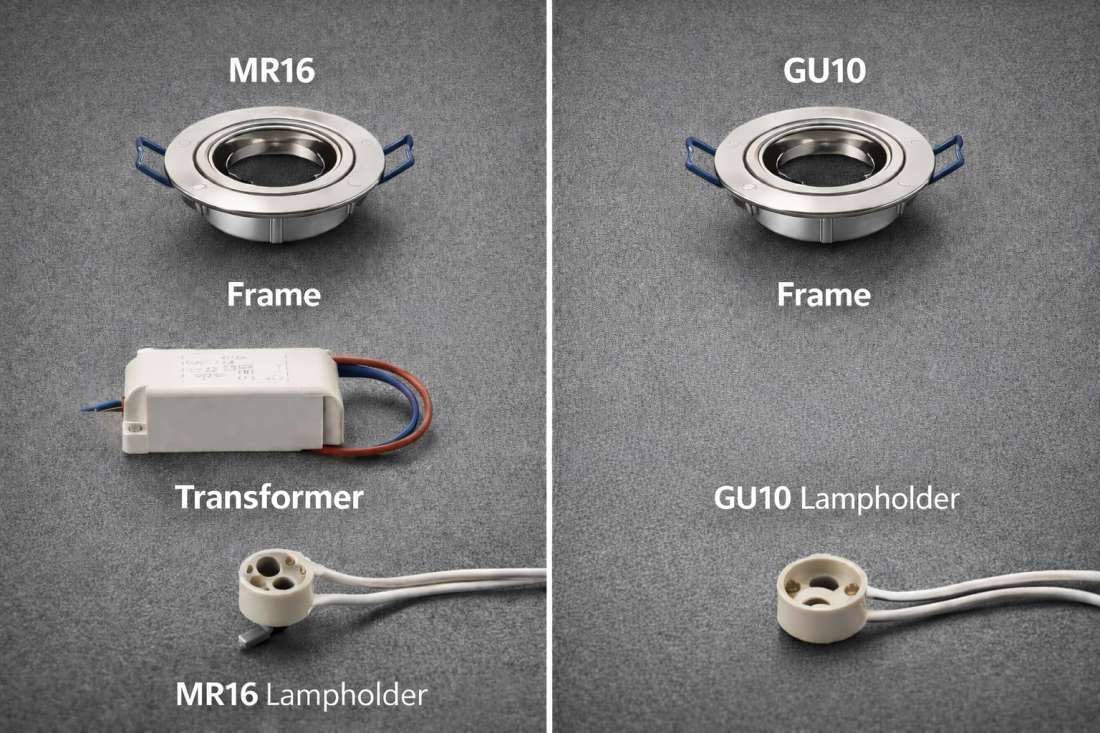
MR16 vs GU10 Downlight Frames (UK): Do You Need a Transformer, and Which Lamp Holder Do You Need?
If you’ve searched for “MR16 / GU10 downlight frames”, you’ll notice many fittings look almost identical. The difference isn’t the bezel — it’s the voltage and the lamp holder behind the scenes.
In this guide we’ll explain:
- what “MR16” and “GU10” really mean in practice,
- when you need a transformer/driver (and when you don’t),
- which lampholder you need for each setup,
- and the most common mistakes that cause flicker, dead lamps, or wrong orders.
Quick answer (30 seconds)
- GU10 (twist-and-lock cap) is typically mains voltage (220–240V) → no transformer required.
- MR16 (G5.3) (two-pin bi-pin cap) is typically low voltage (usually 12V) → transformer/driver required.
- Many “MR16 / GU10” frames are supplied with a G5.3 lampholder for MR16, and you add a GU10 lampholder if you want to run GU10 lamps.
If you’re unsure about the naming confusion (MR sizes vs GU base types), read: GU10 vs MR16 vs MR11 vs GU11: What’s the Difference?
Downlight frame vs lamp holder: what’s the difference?
A downlight frame (also called a bezel or fitting) is the metal surround that sits in the ceiling. A lamp holder (lampholder) is the electrical connector that actually mates with the lamp base.
Many frames are designed to accept the same 50mm lamp face (the common “spotlight size”), but the lampholder behind it determines whether you’re running GU10 (mains) or MR16 G5.3 (low voltage).
Do I need a transformer/driver?
GU10 (mains 230V)
- Most GU10 ceiling downlights run directly on 220–240V mains.
- You normally do not use a transformer.
- You need a GU10 lampholder and a GU10 lamp.
Example accessories and lamps: GU10 Ceramic Lamp Holder – White Ceramic · GU10 5W 450lm Warm White (3000K) 120°
MR16 (G5.3 low voltage, typically 12V)
- MR16 (G5.3) lamps are designed for low voltage and need a transformer/driver.
- Commonly this is a 12V supply (often hidden above the ceiling), but always match the lamp’s voltage rating.
- You need a G5.3 bi-pin lampholder and an MR16 (G5.3) lamp.
Our new wide-beam MR16 (G5.3) options (bright, even coverage): 8.5W 2700K Warm White (Wide Beam) · 8.5W 4000K Neutral White (Wide Beam) · 8.5W 6500K Cold White (Wide Beam)
Safety note: If you’re changing transformers/drivers or converting between 12V and mains, use a qualified electrician and follow current UK wiring regulations.
Which lamp holder do I need?
For GU10 lamps
- You need a GU10 lampholder (twist-and-lock).
- Example: GU10 Ceramic Lamp Holder – White Ceramic.
For MR16 (G5.3) lamps
- You need a G5.3 bi-pin lampholder (two straight pins).
- Many MR16 / GU10 frames are supplied with a G5.3 lampholder already fitted (ready for MR16).
Example frames (MR16/GU10 compatible frames)
These frames take standard 50mm lamps. They’re supplied ready for MR16 (G5.3), and you add a GU10 lampholder if you want to run GU10 lamps.
- Chrome MR16 / GU10 Recessed Ceiling Downlight
- White MR16 / GU10 Recessed Ceiling Downlight
- Satin MR16 / GU10 Recessed Ceiling Downlight
Browse all downlight frames, lamps and accessories here: Shop all products
Common mistakes (and quick fixes)
- Putting an MR16 (G5.3) lamp into a GU10 circuit
Fix: MR16 (G5.3) needs a low-voltage transformer/driver and a G5.3 lampholder. - Assuming “MR16” always means 12V
Fix: “MR16” describes the lamp face size. The base type (e.g. G5.3 vs GU10) tells you what it fits and the typical voltage. - LED flicker on an old halogen transformer
Fix: swap to an LED-compatible transformer/driver (older electronic transformers can have minimum-load issues). - Ordering a frame without checking the cut-out size
Fix: measure your ceiling hole and compare before ordering.
Next steps (helpful guides)
- Downlight cut-out sizes explained (UK)
- Best downlight colour temperature for UK homes
- Downlight beam angle explained: 38° vs 120°
- How many downlights do you need? UK spacing guide
- Bathroom downlights: IP44/IP65 zones guide
Want us to sanity-check your setup? Send us: (1) what lamp you currently have, (2) whether there’s a transformer in the ceiling void, and (3) your cut-out size — and we’ll point you to the right frame + lampholder + lamp.