
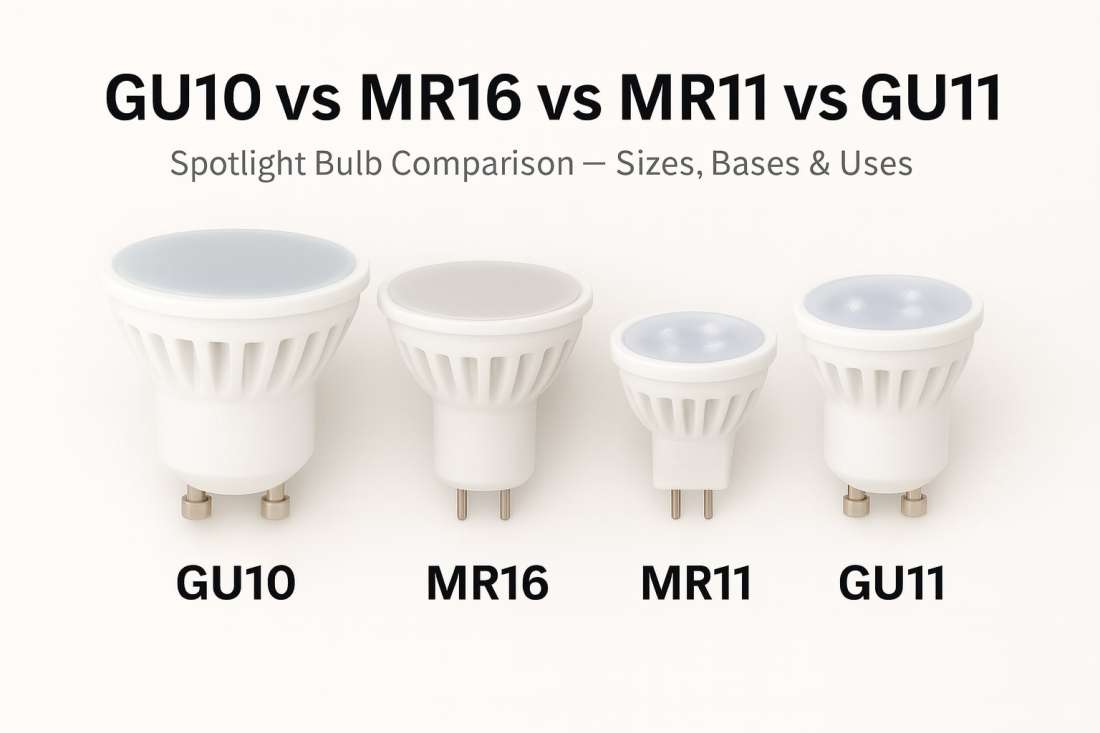
Choosing the right spotlight lamp shouldn’t feel like decoding a secret language — but terms like GU10, MR16, MR11 and GU11 often get mixed up because they describe different things. Some refer to the lamp size, others refer to the base/cap, and some combinations exist in the real world (which adds to the confusion).
This guide explains what each term means, how they relate to one another, and the quick checks that help you buy the correct bulb and downlight fitting first time.
Quick answer (30 seconds)
- MR numbers (MR11 / MR16) describe the diameter of the lamp face in eighths of an inch (so MR16 is larger than MR11).
- GU codes (GU10 / GU11) describe the cap/base type and pin spacing/mechanism.
- In most UK homes: GU10 lamps are usually mains voltage (220–240V), while many MR16/MR11 “bi-pin” lamps are low voltage and need a transformer/driver.
- Always match the base type first (GU10 vs 2-pin), then check lamp diameter (35mm vs 50mm), then confirm your downlight cut-out size.
Shop downlights, frames and compatible fittings
What do “MR” and “GU” actually mean?
MR = lamp face diameter
MR stands for multifaceted reflector. The number (e.g. 11 or 16) is the diameter of the lamp’s face measured in eighths of an inch:
- MR16 = 16/8" = 2" ≈ 50mm diameter
- MR11 = 11/8" = 1.375" ≈ 35mm diameter
GU = base/cap type
GU refers to the lamp cap format. With GU caps, the number typically relates to the pin spacing (and the mechanism differs by type):
- GU10: the common UK “twist-and-lock” spotlight cap used in many ceiling downlights.
- GU11: a smaller spotlight format often associated with a 35mm face (commonly used where a more compact lamp is needed).
GU10 vs MR16 vs MR11 vs GU11: comparison table
| Type | What it describes | Typical face diameter | Typical voltage (UK) | Where you’ll see it |
|---|---|---|---|---|
| GU10 | Cap/base type | Usually 50mm spotlight face | Usually 220–240V mains | Most modern domestic ceiling downlights |
| MR16 | Lamp size (reflector diameter) | 50mm | Often 12V (when bi-pin) or mains when paired with GU10-style caps | Downlights, display lighting, older installations |
| MR11 | Lamp size (reflector diameter) | 35mm | Often low voltage (when bi-pin) | Compact fittings, cabinet/display and tighter apertures |
| GU11 | Cap/base type | Commonly 35mm spotlight face | Varies by lamp/fitting (commonly mains-style compact spots) | Compact downlights where a 50mm lamp won’t fit |
The most common mix-ups (and how to avoid them)
1) Confusing “GU10” with “MR16”
Many people say “MR16” when they actually mean a 50mm spotlight lamp — and in everyday UK use that often ends up being a GU10 lamp in a GU10 downlight. The key point is this:
- MR16 describes the size (50mm face).
- GU10 describes the cap (twist-and-lock) and is commonly used on 50mm lamps in UK ceilings.
2) Ordering the right bulb but the wrong cut-out
Your ceiling cut-out size is determined by the downlight fitting (the frame/body), not just the lamp. Two different downlights can both take a GU10 lamp, yet require different cut-out sizes.
Tip: before ordering, check:
- Downlight cut-out size (in mm)
- Required lamp type (GU10 / compact / low voltage)
- Overall depth (important for shallow ceilings)
- IP rating if fitting in bathrooms or damp areas
Browse downlights and frames here — open a product and check the cut-out size and lamp compatibility before you buy.
3) Mixing mains and low-voltage lamps
Some spotlight lamps are designed for mains voltage (220–240V), while others are designed for low voltage and require a transformer/driver. If you’re unsure, check the label on the fitting, the driver, or the existing lamp.
Safety note: Always isolate power before inspecting fittings. If you’re not confident, use a qualified electrician — especially in bathrooms and other regulated zones.
Which one should you choose?
Choose GU10 when…
- You have standard UK ceiling downlights that take a twist-and-lock GU10 lamp.
- You want a wide choice of beam angles and colour temperatures in a familiar format.
Choose MR16 (50mm) when…
- Your fitting needs a 50mm lamp but may be low voltage (common in older setups).
- You’re replacing an existing system with a transformer/driver already in place.
Choose MR11 (35mm) or GU11 when…
- You have a compact fitting where a 50mm lamp physically won’t fit.
- You’re doing detail lighting (smaller aperture, tighter space, more “precise” look).
Shop compatible downlights and fittings
Buying checklist (use this before you order)
- Base type: GU10 / GU11 / 2-pin (look at the holder)
- Lamp face size: 50mm (MR16-ish) vs 35mm (MR11-ish)
- Voltage: mains vs low voltage (check fitting/driver)
- Cut-out size: measure the ceiling hole or check the downlight spec
- IP rating: especially for bathrooms and kitchens
- Beam angle + colour temperature: match the room and the task
FAQs
Is MR16 the same as GU10?
Not exactly. MR16 refers to a 50mm lamp size. GU10 refers to the cap type. Many UK ceiling spots use a GU10 cap on a 50mm lamp, which is why the terms get used interchangeably.
Is MR11 always low voltage?
Not always — but MR11 is commonly seen in low-voltage formats when paired with 2-pin bases. Always confirm what your fitting actually takes before ordering.
What’s the difference between GU10 and GU11?
In simple terms: GU11 is typically the smaller compact spotlight format (often around 35mm face) used where there isn’t space for a standard 50mm GU10-style lamp. Always match the fitting type and product spec.
Ready to choose? Browse all downlights, frames and fittings and check the cut-out size and lamp compatibility on the product page.