
Downlight Beam Angle Explained (UK): 38° vs 120° — What Should You Choose?
If you’ve ever bought a “spotlight” and then wondered why the room still feels patchy (or why your downlights are creating harsh bright circles), beam angle is usually the missing piece.
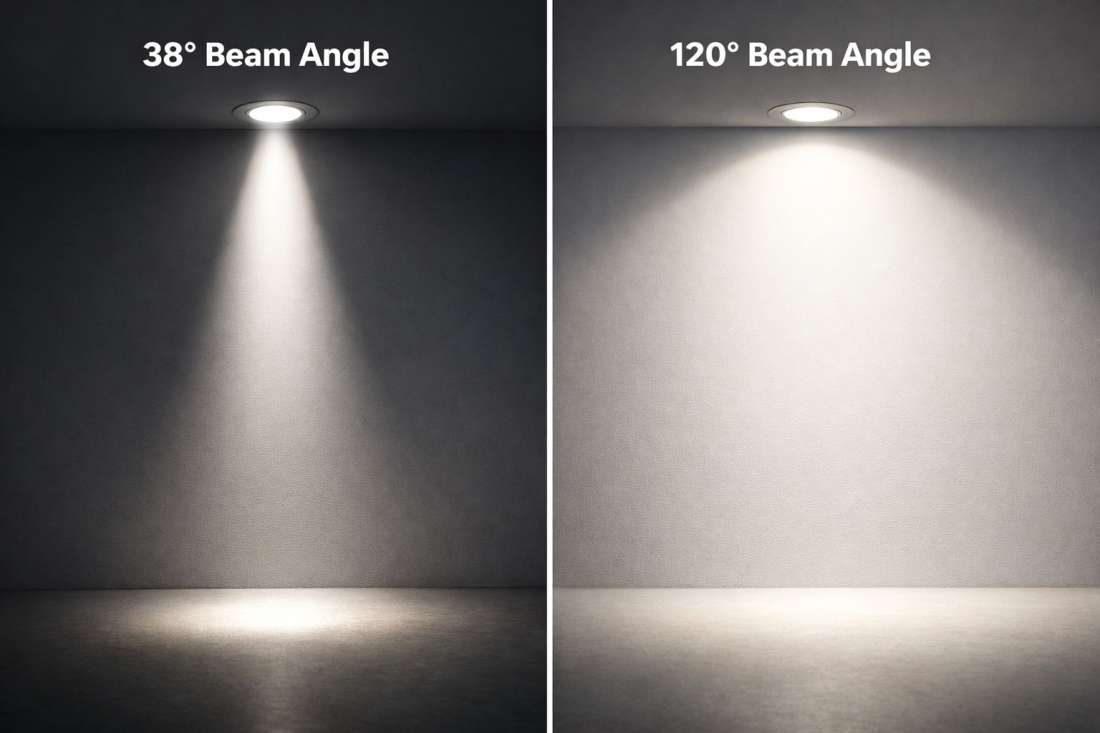
Beam angle is shown in degrees (for example 38° or 120°) and it describes how wide the light spreads. A narrow beam gives a more focused “spot” effect. A wide beam gives smoother, more even coverage — often with fewer hot-spots.
In this guide we’ll explain:
- what beam angle actually means,
- which angles suit different rooms in a UK home,
- how beam angle affects spacing and the “look” of your lighting,
- and how to choose between narrow-beam accent lighting and wide-beam general lighting.
What is beam angle (in simple terms)?
Beam angle is the width of the cone of light coming out of the lamp.
- Narrow beam (e.g. 24°–40°) = more “spotlight” effect, stronger shadows, more contrast.
- Medium beam (e.g. 45°–60°) = a balance between punch and coverage.
- Wide beam (e.g. 90°–120°) = softer, more even light spread, fewer bright circles.
A good way to think about it:
- Narrow beams highlight things.
- Wide beams light areas.
Quick cheat sheet: best beam angles by use
Choose a narrow beam (around 38°) when you want:
- accent lighting (alcoves, shelves, artwork),
- feature lighting (textures, brick, wall washing in small areas),
- cabinet/display lighting where you want direction and “pop”.
Choose a wide beam (around 120°) when you want:
- general lighting across a room,
- smoother coverage with fewer harsh spots,
- kitchen/hallway lighting where you want “even” rather than “dramatic”.
38° vs 120°: what difference will you actually see?
38° (typical “spot” beam)
A 38° lamp creates a defined pool of light. It’s great for:
- highlighting a feature,
- adding sparkle to displays,
- directing light where you want it.
Example from our range: MR11 (GU4) LED Spotlight Bulb 12V 3W Neutral White (Ceramic) — 255lm with a 38° beam (ideal for compact fittings and directional accents).
120° (typical “wide” beam)
A 120° lamp spreads light much more widely, so the ceiling looks more evenly lit and you get fewer “bright circles”.
Example from our range: GU10 LED Spotlight Bulb 5W 450lm – Warm White (3000K) — a wide 120° beam designed for clean, even general lighting.
If you want a softer “marker” style light (not bright general lighting), we also stock low-output GU10 lamps like: GU10 1W 60lm (2700K) or GU10 1W 80lm (3000K, glass) with wide spread for subtle ambience.
Beam angle + brightness (lumens): the combo that matters
Beam angle and lumens work together:
- A narrow beam concentrates the same lumens into a smaller area, so it looks brighter in the centre.
- A wide beam spreads lumens out, so it looks smoother, but the “centre punch” is less intense.
That’s why a 255lm narrow-beam accent lamp can feel surprisingly punchy on a feature, while a 450lm wide-beam lamp can feel “comfortable” across a whole area.
Tip: If your downlights feel “glary” or too contrasty, you often want a wider beam, not necessarily fewer lumens.
Best beam angle for kitchens (UK homes)
Most kitchen ceilings benefit from wide or medium-wide beams, because you want:
- even coverage across walkways and work areas,
- fewer harsh pools of light,
- less “striping” or bright circles on the floor.
A wide-beam GU10 (like a 120° general-lighting lamp) is often a safe choice for main kitchen lighting — especially if you’re combining downlights with under-cabinet lighting.
For feature areas (like open shelving, a coffee nook, or a display cabinet), that’s where a narrower beam (around 38°) can be perfect.
Best beam angle for bathrooms
Bathrooms are similar to kitchens in terms of how the light should feel (clean and even), but you also need to match the right IP rating to the correct bathroom zone.
As a general rule:
- wide beam for overall bathroom lighting,
- narrow/medium beam only where you’re deliberately highlighting a feature (like a niche).
If you haven’t read it yet, check our guide: Bathroom Downlights IP44 & IP65 Ratings Guide.
How beam angle affects spacing (and how many downlights you need)
Beam angle changes the “coverage circle” on the floor/working plane:
- With wide beams, the circles overlap more easily, so the room looks uniform.
- With narrow beams, you can get noticeable bright/dark patches unless you use more fittings or place them carefully.
If you’re planning a full ceiling layout, use our spacing guide next: How Many Ceiling Downlights Do You Need? UK Spacing Guide.
Rule of thumb:
- If your ceiling looks spotty, you’re often too narrow (or spaced too far apart).
- If the room looks flat but even, you’re often wide-beam and correctly spaced.
Common beam angle mistakes (and easy fixes)
- Using narrow beams everywhere
Result: harsh pools of light + dark gaps.
Fix: switch main lighting to a wider beam and keep narrow beams for features. - Assuming “spotlight” always means narrow
Many GU10 LEDs are wide-beam by design (great for general downlight coverage). - Mixing beam angles in the same ceiling
Result: some areas look “punchy” and others look “washed out”.
Fix: keep one beam angle for the main grid; use a different beam angle only for a separate feature zone. - Chasing watts instead of lumens
Modern LEDs vary massively. Compare lumens + beam angle, not just watts. - Not matching lamp type to the job
For compact accent fittings, MR11 lamps are great because they’re small and directional. For simple general lighting, wide-beam GU10 lamps are often the easiest route.
Product examples (so you can choose faster)
- General lighting (wide, even spread): GU10 5W 450lm, 120° beam
- Directional accent lighting (focused spot): MR11 12V 3W 255lm, 38° beam
- Low-brightness ambience / marker lighting: GU10 1W 60lm, 120° beam
Browse our products and check both beam angle and lumens in the specifications before ordering.
FAQ
Is 38° too narrow for a room?
For main room lighting, 38° can look spotty unless you add more fittings or use it only in feature zones. For accent lighting, 38° is ideal.
Is 120° too wide for downlights?
Not at all. Wide beams are often better for modern rooms because they reduce harsh pools of light and give a more uniform ceiling.
What beam angle is best for hallways?
Wide beams are usually best because hallways are narrow and you want smooth coverage without “hot spots”.
Beam angle vs colour temperature — which matters more?
Both. Colour temperature changes the feel (warm vs crisp), while beam angle changes the shape and uniformity of the light.
Next steps
- If you’re still planning hole sizes, read: Downlight cut-out sizes explained.
- If you’re deciding warm vs neutral lighting, read: Best downlight colour temperature for UK homes.
- If you’re planning a layout, read: How many downlights do you need? UK spacing guide.
- If you’re choosing lamp formats, read: GU10 vs MR16 vs MR11 vs GU11.
Ready to buy? Visit our shop and choose the right lamp + beam angle for your project.