
Fire-Rated Downlights Explained (UK): When You Need Them and What 30/60/90 Minutes Means
Every recessed downlight starts with a hole in the ceiling. What many people don’t realise is that in a typical UK house, that ceiling is doing a safety job: it slows a fire spreading from one floor to the next. Cut a 70mm hole in it and you’ve created a shortcut for flames and smoke — unless the fitting itself closes that gap.
That’s exactly what a fire-rated downlight does. In this guide we’ll cover:
- what makes a downlight “fire-rated”,
- when UK building regulations expect you to use them,
- what 30, 60 and 90-minute ratings mean,
- insulation, acoustics and other things fire-rated cans help with,
- what to check before you buy.
What makes a downlight fire-rated?
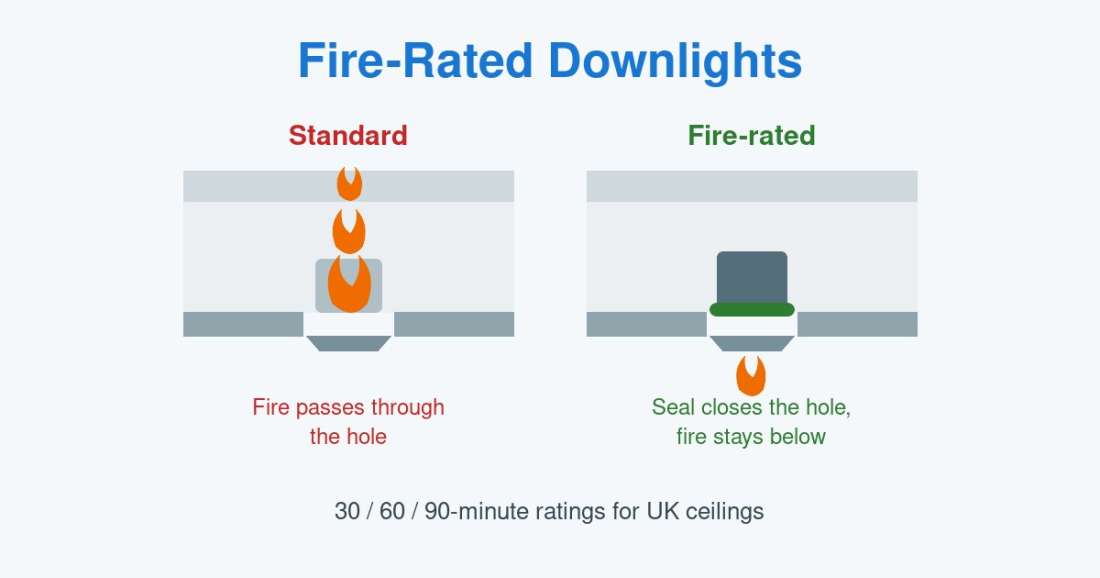
A fire-rated downlight has a sealed body (often called a “can”) with an intumescent pad or ring. In normal use it just sits there. In a fire, the intumescent material expands rapidly with heat and seals the hole you cut, restoring the ceiling’s ability to hold back fire for its rated time.
A standard, non-rated downlight is essentially an open hole with a lamp in it. In a fire, heat and smoke pass straight through into the floor void above — which can dramatically reduce the time a ceiling holds back the fire.
When do you need fire-rated downlights in the UK?
The short version: whenever the ceiling you’re cutting into forms part of a fire-resisting floor, the fitting shouldn’t reduce that resistance. In practice that commonly means:
- Ceilings between storeys of a house — the ground-floor ceiling under bedrooms is the classic case.
- Flats and HMOs — ceilings between dwellings have stricter (often 60-minute) requirements.
- Loft conversions — the floor below a converted loft usually needs to achieve a higher fire rating, so downlights in the ceiling below must match.
- Integral garages — the ceiling between a garage and habitable rooms above is a fire barrier.
Where the ceiling is not a fire barrier — for example directly under a cold, uninhabited loft in a bungalow — fire-rated fittings may not be strictly required. But many electricians fit them everywhere anyway: the price difference is small and it removes any doubt.
Important: building regulations are applied to your specific property and construction. This guide is a plain-English overview — for anything structural, confirm with your electrician or building control.
What do 30, 60 and 90 minutes mean?
The rating tells you how long the fitting preserves the ceiling’s fire resistance, and it should match the ceiling construction it’s installed in:
- 30 minutes — typical for standard ceilings in two-storey houses.
- 60 minutes — common for flats, three-storey homes and loft conversions.
- 90 minutes — heavier-duty constructions and some commercial settings.
Most quality fire-rated downlights sold in the UK are tested and certified for all three (“30/60/90”), tested to BS 476 or the equivalent EN standards — check the certification on the datasheet rather than just the marketing copy.
Other benefits: insulation, draughts and sound
Because the can is sealed, fire-rated downlights also help with:
- Air leakage — an open downlight hole is a draught path; sealed cans reduce heat loss.
- Acoustics — a sealed ceiling transmits less airborne sound between floors.
- Insulation contact — many (not all) fire-rated fittings can be covered with loft insulation. Look for an IC rating or explicit “insulation coverable” statement; never bury a fitting that isn’t rated for it.
What to check before you buy
- Fire rating — 30/60/90 certification appropriate to your ceiling.
- Cut-out size — measure existing holes before ordering; our cut-out finder and cut-out size guide cover this in detail.
- Lamp type — GU10 mains fittings are the simplest swap; see our GU10 vs MR16 guide if you’re unsure what you have.
- IP rating — bathrooms need IP44/IP65 depending on zone; our bathroom IP guide explains the zones.
- Insulation — if your loft is insulated above the fitting, check it’s rated for coverage.
The bottom line
If the ceiling you’re recessing into separates floors — and in most UK houses it does — fit fire-rated downlights. They cost only a little more than standard fittings, restore the fire protection you cut away, and quietly improve draughts and sound too. Browse our range of downlight frames and fittings, and if you’re unsure what suits your ceiling, get in touch — we’re happy to advise.