
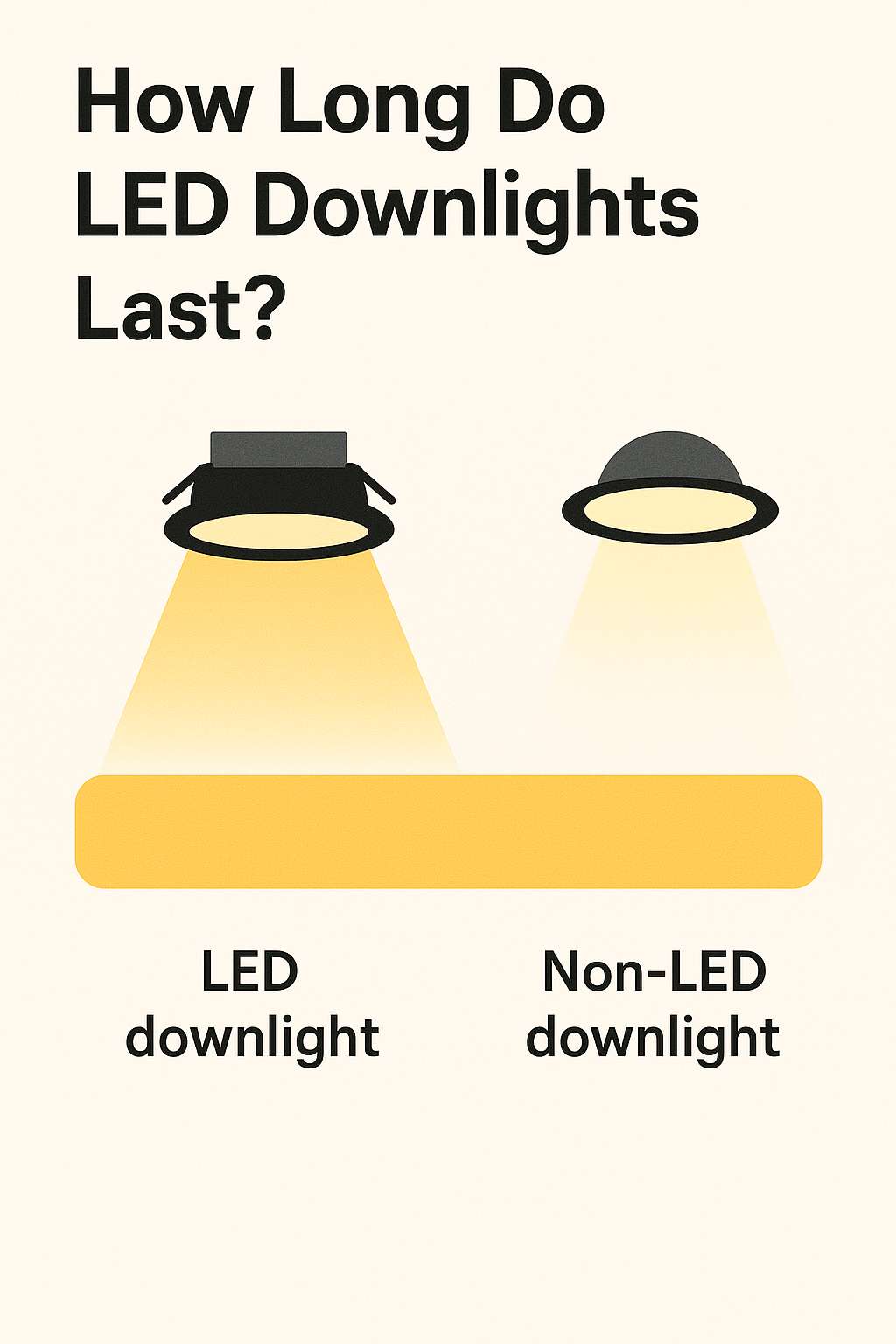
How long do LED downlights last?
One of the biggest advantages of LED downlights over old halogen fittings is lifespan. A modern LED downlight is designed to run for tens of thousands of hours before it noticeably fades, but what does that really mean in everyday use?
What does LED lifespan actually mean?
When you look at a spec sheet for an LED lamp or integrated downlight, you will usually see a figure like 25,000 hours or 50,000 hours. This is not the point where the LED suddenly fails – it is the point where the light output has dropped to around 70% of its original brightness under test conditions.
This is often shown as an L70 rating (for example, L70 25,000h):
- L70 – the level where the light is at 70% of its original output.
- 25,000h / 50,000h – the number of hours the manufacturer expects it to take to reach that point.
In normal use you will usually replace the lamp or fitting for other reasons (style change, room re-fit) before you ever hit the absolute end of life.
How long is that in real years?
The actual years you get from a downlight depend on how many hours a day you use it. Here are some simple examples.
| Rated life | 3 hours per day | 6 hours per day | 12 hours per day |
|---|---|---|---|
| 25,000 hours | approx. 22–23 years | approx. 11–12 years | approx. 5–6 years |
| 50,000 hours | approx. 45+ years | approx. 22–23 years | approx. 11–12 years |
Real homes are somewhere in the middle:
- Living rooms & bedrooms – often 3–5 hours per evening.
- Kitchens & bathrooms – short, frequent use spread across the day.
- Hallways & landings – short bursts as people move around.
In a typical UK home, a good quality LED downlight can easily last 10–20 years before it noticeably fades.
Integrated LED downlights vs GU10 / MR16 lamps
Integrated LED fittings
With an integrated LED downlight, the LED module and driver are built into the fitting itself. You usually replace the whole fitting if something fails.
- Advantages: very slim designs, good thermal management, often very long rated lifespans.
- Disadvantages: when the LED eventually fails you have to change the entire fitting, not just a lamp.
GU10 / MR16 lamps in separate frames
This is the style we focus on at Spot Downlights – separate ceiling frames and GU10 / MR16 / MR11 lamps. The frame is fixed in the ceiling and you simply swap the lamp when needed.
- Advantages: easy to upgrade or replace lamps, you can change colour temperature or beam angle later.
- Disadvantages: lifespan depends on the quality of the lamp you choose and how it is used.
In both cases, choosing good quality lamps and drivers is what gives you long, reliable service.
What shortens the life of LED downlights?
LEDs do not like stress. Anything that makes them run hotter or rougher than intended can reduce their lifespan.
- Excess heat – insulation packed tightly around fittings, no air space above the ceiling or very hot lofts can make LEDs run hotter.
- Poor ventilation in fire-rated cans – always use fittings designed to be fire-rated rather than closing off ventilation yourself.
- Cheap or incompatible dimmers – an incorrect dimmer can cause flicker, buzzing and premature failure.
- Low-quality power supplies / drivers – failures are often down to the driver rather than the LED chip itself.
- Frequent switching – LEDs cope well with on/off cycles, but very rapid switching over many years can still add wear.
- Moisture and steam – in bathrooms, always choose downlights with a suitable IP rating for the zone.
If you control heat, moisture and electrical stress, your LED downlights will typically last close to their rated life.
Signs your LED downlight is reaching the end of its life
- The light looks noticeably dimmer than other fittings in the same room.
- The colour has shifted slightly – it may look more yellow or more blue than it used to.
- You see occasional flicker or the lamp takes a moment to start.
- The lamp goes off and on again if you tap the fitting (often a sign of a failing lamp or driver).
When this happens, it is usually time to replace the lamp. In integrated fittings your electrician may recommend replacing the entire downlight.
Replace the lamp or the whole fitting?
In most homes there are two scenarios:
1) Separate frame + GU10 / MR16 lamp
If you have a separate frame (like the ones we specialise in), you simply:
- Isolate the power safely.
- Remove the old lamp from the holder.
- Fit a new LED lamp of the same cap type and suitable wattage.
The frame stays in the ceiling, so your plasterwork and paint are untouched.
2) Integrated LED downlight
For integrated fittings, the LED and driver are built into the unit. When it eventually fails, replacing the whole downlight is usually the neatest option – speak to a qualified electrician to match cut-out size, fire rating and IP rating.
Are LED downlights worth it compared with old halogens?
Even before you look at lifespan, LEDs win on running costs:
- A typical old 50W halogen downlight is often replaced by a 4–6W LED downlight.
- This is around 85–90% less power for similar or better light levels.
- Over thousands of hours of use, the energy savings easily pay for the higher purchase price.
When you add in the much longer lifespan and the fact you are not constantly changing lamps in the ceiling, LED downlights become a very low-maintenance option for most UK homes.
Where layout and spacing still matter
Long-lasting LEDs will not look their best if they are in the wrong place. It is still important to plan:
- How many downlights you need in each room.
- How far apart they should be on the ceiling.
- How close they sit to walls, cupboards and showers.
If you have not already done your layout, read our spacing guide next:
How many ceiling downlights do you need? UK spacing guide
For bathrooms, combine good layout with the right IP ratings and zones:
Bathroom downlights IP44 vs IP65 and zones explained
Final checklist before you choose your downlights
Before you order frames and lamps, run through this quick list:
- I have checked the rated life (hours) and chosen a reputable brand.
- My fittings have enough space and ventilation above the ceiling.
- Any dimmers I use are compatible with LED.
- Bathroom downlights have the right IP rating for each zone.
- I have planned my layout and spacing so light is even across the room.
- I know whether I am using integrated LEDs or separate lamps in frames, and how they will be replaced in future.
Choose good quality LED downlights, give them a sensible environment to run in, and they will quietly do their job for many years without fuss. Once you are ready to pick frames and finishes, you can browse our specialist range of ceiling downlight frames and fittings here:
Shop ceiling downlights